The New Digital SAT and PSAT

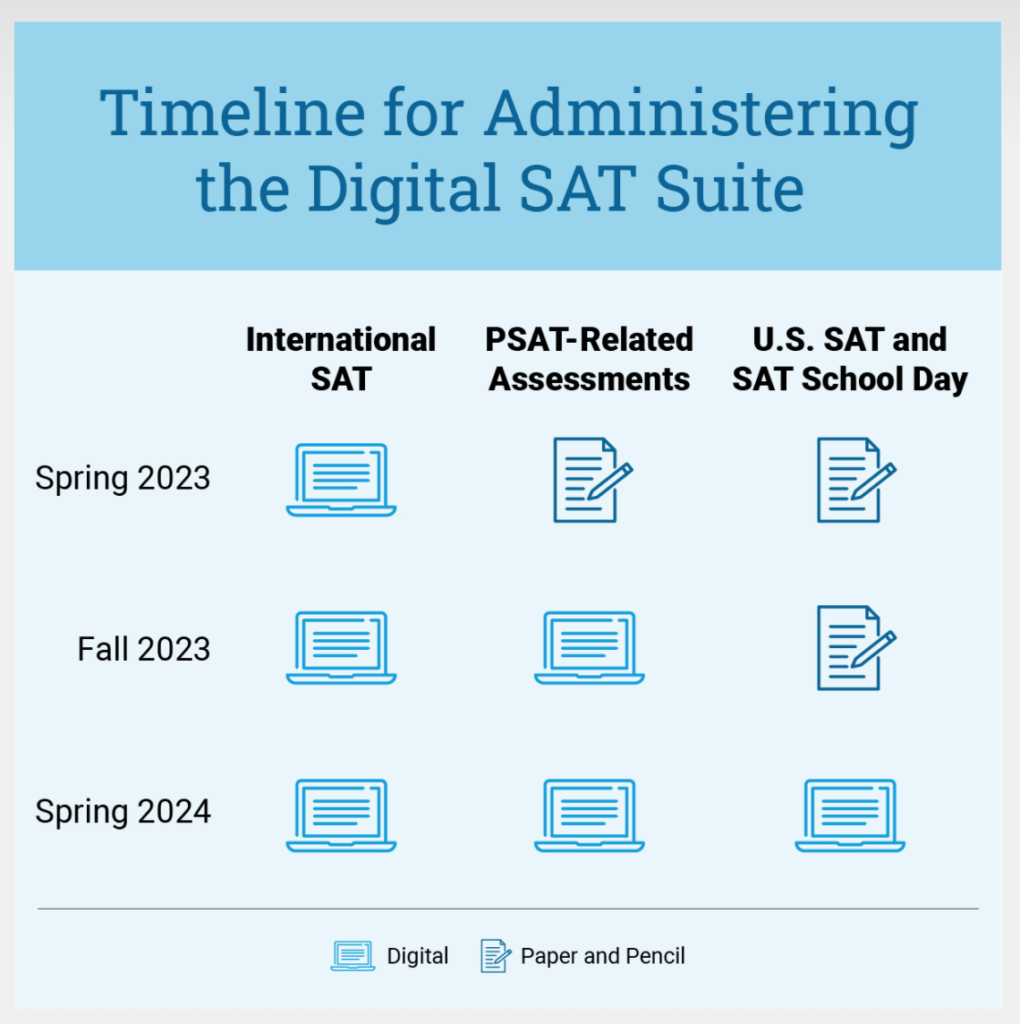
The College Board announced that the SAT and PSAT are updating to a digital format over the next 2+ years. Here is anticipated timeline for these changes:
This image has an empty alt attribute; its file name is image-1-1020x1024.png
Source: The College Board

For current sophomores, juniors, and seniors in the United States, these updates will have no impact on their SAT test experience. Freshmen are scheduled to take the digital PSAT in the fall of their junior year–that will be their first experience with the updated digital format. These same freshmen would then be on track to take the digital SAT in the spring of their junior year–over two years from now.


What will be different on the digital SAT and PSAT?

  • The test will be adaptive. Students will take one Reading/Writing question module, and the second Reading/Writing question module will be different depending on the performance on the first section–the math section will also have this two module format. Students who performed well on the first module will receive more difficult questions in the second module, and those who did not perform as well will receive less difficult questions.
  • The digital SAT and PSAT will be shorter. Instead of taking around 3 hours, the new digital SAT will take around 2 hours. As with other adaptive tests like the GRE, the College Board hopes to obtain the same information about students’ skills in a shorter amount of time.
  • Calculators will be permitted throughout the math section. The digital SAT will have a built-in calculator program (apparently much like the one found on the Desmos website). Students will still be able to bring their own approved calculators if they prefer. Roughly a third of the current SAT math is done without a calculator.
  • Students will take the test on a laptop or desktop computer. If students do not have a computer, they will be given one to use. The computer will have a testing program that will lock down other parts of the computer, so students will not be able to surf the web or chat during the SAT. Students will be able to download the testing software on their personal devices prior to test day.
  • Schools will have more flexibility as to when they offer the in-school SAT. Currently, there are a handful of designated days allowed for test administration. With the digital SAT, schools will be given a month or so over which time they can administer the SAT to different groups of students over different days.
  • There will be shorter reading passages. At this point, we do not clearly know if the new SAT Reading will continue to have longer reading passages. We do know that the digital SAT will have at least a few shorter reading passages that have one question tied to them. I personally am skeptical that the SAT will retain its predictive validity unless they continue to have longer reading passages–after all, students read longer materials in college. I hope to get more clarity on this issue soon and I will update you as soon as I can.
  • The test should be more secure. It will no longer be possible for cheaters to obtain copies of the questions and passages they will find on their test, since the test will be adaptive. This change is especially important for international SAT testing, which has been plagued by test score cancellations because of test security issues.
  • Students will receive more helpful career and college information. The College Board is making a concerted effort to connect students not just to four-year college programs, but to vocational and trade programs. So even if a student is not planning on going to college, the SAT will still provide targeted and relevant career guidance.
  • Scores will be available more quickly. Currently it takes weeks to receive SAT test scores; digital scores will take less time to be available.

What will be the same on the digital SAT and PSAT?

  • The SAT and PSAT will still test the same fundamental skills. Unlike the last major test revision in 2015, this is not a complete redesign of the SAT; it is principally a change in formatting. Students will still need to demonstrate skills in reading comprehension, grammar & editing, and mathematical problem solving.
  • Scores will remain the same. The SAT will still be out of 1600, giving colleges the same metrics they have relied on for several years.
  • Minimal changes to test preparation should be required. The SAT will continue to provide its free resources on Khan Academy, helping students bolster their skills in reading, grammar, and math. As a tutor, my recommendation to current freshmen would not change–do not worry about full practice tests at this point; focus on taking rigorous classes in school, and reading widely outside of school. When the GRE shifted from a paper-based to a digital/adaptive format, very few test preparation changes were needed; I would anticipate a similar situation with the digital SAT.
  • Colleges still want to see your test scores. Please see my post on 5 reasons to take the SAT and ACT for more details.

What comes next for the digital SAT and PSAT?

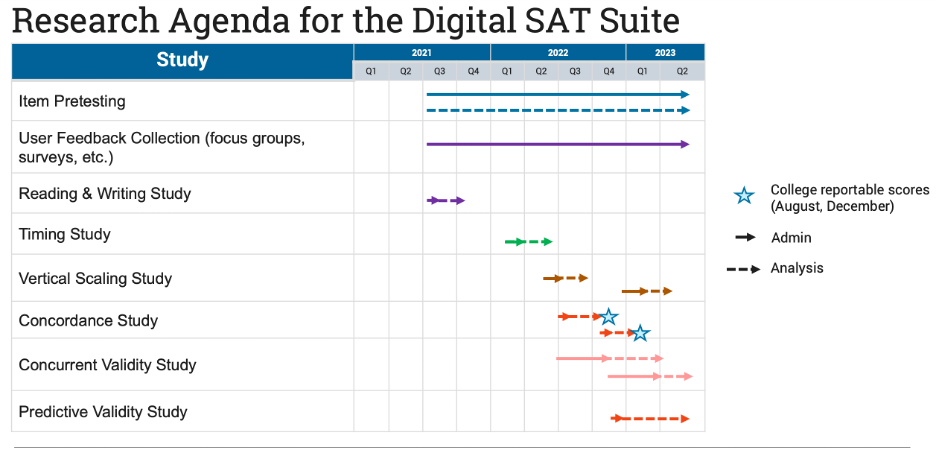
The most important thing for any standardized test is to clearly demonstrate that it can make valid, fair predictions. So far, the digital SAT has only been administered in a pilot program to fewer than 500 students around the world. The College Board outlined their extensive research agenda for the digital SAT over the next 2.5 years:
This image has an empty alt attribute; its file name is image.png
Source: The College Board

If the College Board cannot clearly demonstrate the predictive validity of the digital SAT, they will have to make adjustments to it or postpone its implementation. Here are some questions they will need to answer before they can pull this off:

  • Will students who bring in their own laptops to the SAT have an unfair advantage over those who are provided one by the test site?
  • Will students who have a specific accommodation that allows them to take the SAT using paper/pencil have an unfair advantage or disadvantage over those who take it digitally?
  • Will students who experience technological outages and interruptions have statistically valid scores as a result?
  • Will the flexibility that the College Board is allowing schools in administering the test lead to a lack of a standardized testing experience?
  • Will the digital SAT withstand efforts by hackers to access the question banks?
  • Will students who live in rural areas have the same access to digital testing as those who live in urban areas? How will differences in Internet speed and availability of computers be handled?

The bottom line is that sophomores, juniors, and seniors do not need to worry about any of these changes. In the coming years, we will know much more about the specifics of the digital SAT as the College Board completes its research trials. If you have questions about the new digital SAT and PSAT, please reach out to us.

5 Reasons to Take the SAT and ACT Tests

Over the past two years, there has been quite a bit of upheaval in the world of college admissions and standardized testing.  Many schools are now “test-optional,” meaning that students can submit SAT and ACT test scores if they would like, but they are not required to do so.  Given the media reports about standardized tests, some parents and students may wonder if they should even bother taking the SAT or ACT.  Here are five reasons why taking the SAT or ACT is a still a wise choice in this uncertain environment. 

1.  Nearly all colleges would like to see your scores.

From what is covered in the news, it sounds like most schools do not care about evaluating your test scores.  According to fairtest.org, the reality is that only 3.7% of U.S. colleges are “test-blind,” meaning they do not consider test scores.  The most well-known test-blind schools are the colleges in the University of California system; the others are predominately smaller liberal arts colleges.  This means that  96.3% of U.S. colleges either require the SAT or ACT or will consider SAT/ACT scores if submitted.  Some, like Georgetown University, West Point, and the University of Florida, have required standardized test results even during the pandemic.  Others, like Ivy League Schools and Big Ten universities, give students the option to submit test scores, recognizing that there have been test site cancellations and health concerns that may have precluded students from being able to test. 

Probably the most well-known example of a test-optional university is Harvard.  When you look at their admissions website, you will see that they would indeed like to see your standardized test results if possible:

“Harvard accepts other standardized tests or other academic credentials if you choose to submit them. In any admissions process, additional information can be helpful. For example, Advanced Placement, International Baccalaureate, A-levels, national leaving examinations, national or international contests, early high school assessment scores such as the PSAT or pre-ACT, or courses taken outside your school during the school year or summer are just some examples of information that could be submitted.”

If you call the Harvard admissions office, they enthusiastically encourage students to submit standardized test results—an admissions officer told me that the majority of applicants do submit test scores, and they would like you to send in your scores if you are able to test.  The bottom line is that colleges prefer as much information as possible to make an admissions decision, and they consider standardized tests an important metric in evaluating applicants. 

2.  Test scores provide protection against grade inflation. 

According to the Department of Education and the College Board, the average High School GPA was 2.68 in 1990, and 3.38 in 2016.  A recent national survey of K-8 parents found that 90% of parents believe that their child is achieving at or above grade level, and that 66 percent think that their kid is above average.  Inflated GPAs may give parents and students an incorrect impression of academic readiness, and they make it more challenging for college admissions officers to differentiate among applicants.  Consider this excerpt from the Harvard admissions website

“Given the wide variation in how students prepare for Harvard – as well as the fact that most applicants and admitted students have outstanding academic records – it is difficult for high school grades to differentiate individual applications. That does not mean that high school grades are unimportant. Students who come to Harvard have done well day to day in their high school studies, providing a crucial foundation for academic success in college, including a 97% – 98% graduation rate.  SAT and ACT tests are better predictors of Harvard grades than high school grades”. 

Good grades are certainly a key part of a successful college application.  However, students will stand out among the applicants if they have good test scores as well. 

3.  Those who submit test scores likely have a better chance of earning admission. 

According to the Future of Higher Education Newsletter, those who submit test scores are admitted at a rate that is often twice as much as those who do not submit test scores.  Here are some examples for applicants in the fall of 2021:

  • Emory: Admit rate 17% (with tests) vs. 8.6% (without tests)
  • Colgate: 25% (with tests) vs. 12% (without tests)
  • Georgia Tech: 22% (with tests) vs. 10% (without tests)

Colleges will happily accept applications from anyone who wishes to submit one—after all, they receive application fees and will see improved selectivity statistics.  Colleges will need to see clear evidence of academic strength in other areas to be confident about students who do not submit test scores.  To have a successful application, students would be smart to include test scores that demonstrate their readiness for college-level work. 

4.  Good test scores can lead to substantial scholarships. 

  • For those seeking major merit awards to Ohio State, like the Maximus, Trustees, Provost, or National Buckeye Scholarship (up to a $54,000 value), the criteria include SAT and ACT scores for those who have been able to take them. 
  • The University of Oklahoma awards out-of-state students who are National Merit Semi-Finalists (based on the PSAT and SAT tests) a $56,000 scholarship to cover four years of tuition. 
  • The University of Alabama gives a Presidential Scholarship for students with perfect ACT/SAT scores.  It includes four years of tuition, a stipend, a research grant, and a book grant, valued at $112,000 over a four year period. 

Three to four hours on a Saturday morning could be the best financial investment a student could make. 

5.  Colleges use ACT and SAT test scores to determine your course placement. 

It is one thing to be admitted to a college; it is another to get started on desired major classes as soon as possible.  Achieving certain section scores can allow students to place out of general education requirements, saving time and money.  Ohio State, among many other schools, use ACT and SAT test scores for English and math course placement.  The University of Louisiana, for example, gives students who score a 28 or above on the ACT English a full semester credit for English 101; those who score over a 30 on the ACT math earn two full semesters of credit for Math 109 and Math 110.  Since the ACT and SAT are designed to measure how likely a student will be successful as a college freshman, taking the tests will highlight areas that students should improve so they can be successful in collegiate coursework. 

I hope you found this information helpful.  Please contact us at www.bwseducationconsulting.com with other questions you may have about the SAT and ACT. 

–Brian Stewart

ACT Reading Update–Visual Quantitative Information Questions

The ACT has announced that at some point during the 2021-2022 school year, students may have an additional question type on the ACT Reading section: Visual Quantitative Information questions. These questions will most likely be found on one of the three Informational Reading passages, as opposed to a fiction passage.

What will these questions be like? Check out this link for some sample visual quantitative information questions. Unfortunately, until tests that have these questions are released, these appear to be the only official sample questions ACT has made available.

Why is the ACT adding this question type to the reading section? Most likely it is because the SAT has done so on the Evidence-Based Reading and Writing section, and the ACT would like to assess similar skills. This is yet another example of how the ACT and SAT tests have increasingly converged in recent years, making it easy for students to transition from one test to the other.

So, what should students who are concerned about these new question types do to prepare? First, go into the ACT reading section with a flexible mindset; if you come across a series of graph analysis questions, know that they will only test you on the information in the reading passage and the graph. No outside knowledge will be required. Second, practice with some SAT reading passages that have graph analysis questions. Each SAT reading section has about 4-5 questions of this type, so you will have far more to work with than the limited sample ACT has provided. Here is a link to several SAT practice tests that you can review.

Best of luck!

When Should You Take the SAT and ACT?

If you are planning on trying to earn a National Merit Scholarship and apply to highly selective colleges and universities, the following general test schedule might be a good fit for you:

  • Take the SAT in August or October of your Junior year–this will help you be well-prepared for the PSAT in October of your Junior year. Since you have one chance to do well on the PSAT for National Merit Scholarship consideration, a “dress rehearsal” with the SAT will be extremely helpful. You may also want to try taking the PSAT as a sophomore for additional practice.
  • Take the ACT in December of your Junior year. This test date has a Test Information Release available so that you can analyze your test questions and answers.
  • Evaluate your PSAT scores and December ACT scores so that you can determine if the SAT, ACT or both tests would be the best fit.
  • Take the ACT, SAT, or both in the spring of your Junior year. Most students improve the second time they take the test, so it is a no-brainer to try the tests at least a couple of times. Consider taking the March or May SAT because of the Question and Answer Service; you can get a copy of your test booklet and answers. Also consider the April or June ACT, since those dates offer the Test Information Release.
  • Take the ACT or SAT again in the summer if needed. If your scores are not quite where you want them to be, try the July or September ACT, or the August or October SAT. Keep in mind that many schools superscore (take the best score from each test section), so you may want to try to improve your weaker test sections. Ideally, if you can have your testing complete by the time you start applying to colleges, you will be much less stressed.

Please keep in mind that the above timeline is a general suggestion, and many other factors should influence when you take the tests. Here are some other things to consider:

  • Does your state offer in-school ACT or SAT tests? If so, you may want to focus on being well-prepared for those test dates. You will get to take the test during the school day in familiar surroundings, possibly giving you an enhanced opportunity to perform well.
  • Is a certain time of year less busy for you because of decreased extracurricular commitments? If you are a fall athlete, perhaps you should focus your preparation on the winter tests. If you have a busy spring, try to get your testing done in the winter.
  • Are you being recruited for sports? Coaches often like to have your test scores as early as possible. You may want to move your testing timeline up a bit if recruiters would prefer that you do so.
  • Are you only applying regular decision? Many students want to weigh different financial aid offers and want more time to consider possible schools. If so, you do not need to have your testing complete until December or January of your senior year.

I hope you found this helpful. If you have questions about the best test-taking timeline for your particular situation, please reach out to us and we would be happy to help.

Thinking Strategically about Early Applications to College

Many students believe that when you apply early to a university, you must limit your application to a single college. When, you look more closely at the application requirements, you will find that you can apply more strategically. Highly selective schools in the United States–like Harvard, MIT, and Yale–have restrictive early action. For example, Harvard describes its Early Action program like this:

“If you apply to Harvard under our Restrictive Early Action program, you may also apply early to non-binding public or foreign colleges/universities (no Early Decision programs), but you may not apply early (in any form) to U.S. private colleges/universities.”

Note that the restriction applies only to U.S. private universities. So, where else could an ambitious student apply?

International Universities. Schools in Canada, like the University of Toronto or McGill, would be excellent candidates. Schools in the United Kingdom, like Oxford and Cambridge, could also be great possibilities. Given the weight that international schools put on academic qualifications, these schools could be good options for students whose academic qualifications are stellar but whose extracurricular qualifications are not as comparatively strong.

Elite State Universities in the United States. Schools like the University of Michigan and the University of Wisconsin would allow early applications that are non-binding.

So, instead of simply applying to one selective private school with an early application, you may want to also apply early to an international university or a couple of state universities. Doing so will likely ensure that you have more options for college admissions come December instead of having all of your eggs in one basket with a single elite private university.

End to SAT Subject Tests and the SAT Essay, and Digital SAT Development

The College Board made some major announcements today. First, they are immediately discontinuing SAT Subject Tests (the one hour tests in subjects like Literature, Math Level 2, and Chemistry) for students in the United States. They will continue to offer SAT Subject Tests for International Students who wish to take them in May or June of 2021. Students may still be able to submit existing scores from SAT Subject tests, but should check with individual colleges on their policies. If you are registered to take an upcoming SAT Subject Test, the College Board will cancel your registration and give you a full refund.

Second, the College Board is phasing out the SAT Essay by June of 2021. Students who need to take the SAT Essay for their state’s school day administration will still be able to take it. All the other parts of the SAT–Reading, Writing & Language, and Math–will remain the same.

Third, the SAT is developing what they call a “more flexible SAT—a streamlined, digitally delivered test.” They will provide more details about this in the spring.

What does all this mean for high school students?

  1. The SAT and ACT will become more important. Students who previously could show their subject knowledge with multiple-choice SAT Subject Tests will no longer have that option. With fewer tests that colleges will consider, each test will become relatively more influential.
  2. AP and IB test results will become more important. One major reason that the College Board gave for eliminating the SAT Subject Tests was that students already have the opportunity to show subject knowledge with AP exams. Top AP test scores–like a 4 or 5–will be a critical component of college applications. If students are in the International Baccalaureate program, scores from those exams can also show college readiness.
  3. There will likely be a digitally adaptive SAT in the future. My best guess as to what the SAT has in store for the digital SAT is a test much like the current GRE. The GRE is adaptive–if you are performing well, you get more difficult questions, and if you are performing poorly, you get easier questions. By having an adaptive format, the digital GRE takes about half the time a paper version of the test would take. I believe that in the coming years, the SAT will be offered both as a longer paper test, and as a shorter digitally adaptive test. A digital version of the test would require much less time for a school-administered version, making it a popular option.

Stay tuned to our blog for the latest updates on SAT test changes.

Distance Learning and Homeschooling Tips

By Michal Strawn

As many students and parents contemplate another semester at home, the question has arisen in most houses as to how to ensure that students have their best optimal outcome despite the big changes that have occurred. I myself was fully homeschooled for eight years and so have a good idea of what some of the difficulties may be when students are expected to learn at home, and I’ve been teaching students online for a few years now, so I understand some of the stresses that teachers face as well. As a student or a parent, here are some ideas for making the most of the online classroom.

Note: most of these tips are best for middle and high school students

  1. Find the right space in your home

By now we’ve all read about a half dozen articles about tele-commuting. The first piece of advice most of them give is for the person working from home to find a space in the home that is just for work. The adult tele-commuter wants a space away from the rest of life where they can mentally be at the office. The same is true for students. I can’t tell you how many students I have who log in from their bedroom floor, or their kitchen counter. They try to learn with their pets crawling on them and their siblings and parents yelling in the background. For success they need a space in the home where when they sit down their mind clicks into school mode. This shouldn’t be a place that is completely private: students often need other people around to keep them on task. It shouldn’t be too comfortable (the couch) or too public (the kitchen counter). Students should look for a semi-private corner or nook where they can have a table or desk with a school-type chair, the possibility of a parent wandering by on a regular basis to check in, a good internet connection, and minimal outside distractions. With multiple siblings logging in, many families have done things like turning each corner of a dining room or rec room into a student space. Look for creative solutions to get each student their own school-only desk space.

2. Find the Right Equipment

Students need to ask their teachers what they will need. A computer and internet are crucial, but expensive. If students have a hard time finding those things, inquire at the school about support. Can you check out a chrome book for the semester? Are there companies offering deals on home Wi-Fi? After these crucial pieces fall into place, I would say the next most important thing is comfortable headphones, especially if the student will be expected to log into live classes on a regular basis (double especially if there are multiple students in the home that will be doing this). Students need to be able to focus on what their teachers are saying. This is very difficult if there is a lot else going on around like siblings trying to learn, mom and dad trying to work, and everyone just trying to live. Good noise cancelling headphones help students get in the school zone and deliver their lessons with high quality audio.

Other pieces of equipment that might be very helpful include a printer/scanner (so students can rest their eyes by doing thing on paper instead of a screen), a webcam to allow them to chat face-to-face with instructors (trust me, teaching is so much easier when you can see your students), and an extension cord so they aren’t tied to outlets when charging.

3. Set time limits

In school almost every activity has a time limit. Classes end, students have to pack up and move on. Having a set amount of time for things forces students to stay focused and gives them a more structured feeling. If they don’t finish the work in their assigned class time, they should make themselves do it for homework when everything else is done. It sounds strange, but it can really help students stay motivated and not end up working all day and getting nothing done.

4. Have a schedule!

Ok, this one should have been number one or two, but it’s been said so often that I feel like it’s obvious by now and it just piggybacks on setting time limits. People who are working or learning from home need to set a schedule and stick to it. Many teachers are not teaching live this fall. That means students don’t have any structure to their days at all! Make. A. Schedule. Set a wake-up time, a math time, a biology time, a lunch time and so on. Structure breeds success. Without structure, students will spend all day doing what could be done in a few hours.

5. Breaks

Speaking of lunch time, students should make sure their schedule includes the breaks that they’re used to. They can and should give themselves a five minute “passing period” every hour and at least half an hour for lunch. During these times they need to get up and actually do something. They shouldn’t spend the five minutes scrolling through Instagram while sitting at the school desk- the school desk is only for school. Instead, they should get up, stretch, grab some water, run out to the mailbox, and use the bathroom. In short–move!

6. Communicate!

Since students are at home and not seeing their teachers every day, the teachers won’t know as quickly if something is wrong. They won’t necessarily notice that the student is quieter than normal, or working slower than they normally would, or missing questions. Students need to be their own advocates this year; don’t wait for teachers to ask–tell! Students should get comfortable reaching out to teachers at least once each week to check in, ask questions, and make sure they aren’t missing anything.

Hopefully these tips will make distance learning a bit more manageable. If we can ever help, just let us know!

-Michal

Help with at-home education this year…

As more and more schools announce that they’ll be shifting students online for at least the first few weeks of the fall semester, parents are once again trying to find a way to balance their work schedules with their student’s at-home schooling. Many schools have switched their methods of distance learning from what they were doing in the spring to a more intensive program now that it seems apparent that distance learning may be necessary for quite some time. In addition, many parents who were working from home in the spring have now returned to their offices leaving older students to work on their own for large portions of the day.

For many students, this will prove a sizeable challenge. Middle and high school students often are not known for being able to self-pace, get ahead of a schedule, stay motivated, and reach out for help when it is needed. With distance learning many teachers may be less available to individual students for questions or concerns; students may fall behind in subjects they don’t enjoy or may slip through the cracks entirely until the end of the semester reveals that weren’t able to keep up.


What students ideally need is someone who can work with them fairly regularly to explain new content, check in on assignment progress, and communicate to parents where improvements need to be made. To that end, some parents and groups of parents across the country are hiring educators to come into their homes and monitor their students’ progress. However, many feel that bringing an outside person into their homes is unsafe and that hiring a full time educator is excessive when the school will be providing the content and lessons.


The solution, then, is check-up education, completed online, with a tutor or educator who can, from a distance, help students stay on track. BWS is offering online tutoring this fall to help with this need. We have tutors who can meet with students daily, weekly, or anything in between, to assist with content and pacing for students in middle and high school. Having these one-on-one meetings with someone besides a parent motivates students to stay on task; it establishes a regular schedule for them; it creates accountability in a system where there might otherwise be none; it ensures that students have their questions answered even when teachers are busy and parents are at work. Most importantly, it happens remotely to keep students safe.


If you’re interested in us setting up a program that would work for your student and his or her needs, please reach out to us at tutor@bwseducationconsulting.com.

Test Optional Colleges—Questions Answered

What does Test Optional mean?

A college that is “test optional” will still consider SAT and ACT test scores as part of your application, but does not require that you submit them.  Schools that call themselves test optional still require many students to submit scores.  Check with the school to see if you may actually need test scores for these situations:

  • Scholarship consideration
  • Transfer students
  • International students
  • In-state tuition
  • Homeschooled students
  • Athletes
  • High school with unconventional grading

The easiest way to find these details is to call the admissions office directly.  There are only a handful of colleges that are “test blind,” meaning they do not review test scores at all.

Given the hardships with Covid-19, what other things may be optional with college admissions in 2020?

About the only uniformly required application component for 2020 is a high school transcript.  Many components that are typically required are optional for 2020.  The specifics vary by school, but here are some commonly waived requirements:

  • Grades for your classes, particularly if your school did not grade in the Spring of 2020.
  • Letters of recommendation
  • College essays
  • Extracurricular activities
  • Additional test scores (AP, IB, SAT Subject tests)
  • College visits and interviews
  • TOEFL for international applicants
  • Portfolios and other supplemental work

Since so many colleges are flexible with their admissions requirements, will it be easier to get in this year? 

No.  In my phone calls with college representatives across the country, university officials anticipate that admissions will be just as competitive if not more competitive than in past years.  The overall trend, particularly among selective schools, is to keep lowering the acceptance rate.  In 2006, for top ten schools, the acceptance rate was 16.0%.  Just 12 years later in 2018, the acceptance rate among top 10 schools was only 6.4%.[1]

Given how competitive admissions and scholarships have become, it is imperative that you provide as much information as possible about your academic and extracurricular qualifications in your application. The more competitive the school, the less likely something that is considered “optional” actually will be so.

Which students should submit test scores to test optional schools and which students should not bother?

  • If your ACT or SAT test scores are at least at the 25th percentile for admitted students, go ahead and submit them.

Approximately 80% of students who apply to test optional schools still submit their scores[2].  Colleges want as much information as they can have about your academic preparedness, so include your scores if they meet this threshold.

  • If your ACT or SAT scores are less than the 25th percentile for admitted students, do not submit them unless you need them for a scholarship or other requirement.
  • If you have not been able to take an ACT or SAT because of health and safety concerns related to Covid-19, then do not worry about submitting your scores. Be prepared to elaborate on why you were unable to take the ACT or SAT in your application.

The bottom line—even though many schools are test optional, to have the most competitive application, solid test scores are a major plus.

[1] https://www.businessstudent.com/topics/college-acceptance-rates-over-time/

[2] https://blog.collegeboard.org/what-is-a-test-optional-college#:~:text=In%20a%20recent%20survey%2C%20representatives,%2C%20the%20ACT%2C%20or%20both.