
I am very excited to share our new Digital SAT e-book! It has a full-length practice test and test-taking tips. The e-book is available to download to your kindle on Amazon.
I am very excited to share our new Digital SAT e-book! It has a full-length practice test and test-taking tips. The e-book is available to download to your kindle on Amazon.
The College Board just released the test specifications for the new digital SAT. Here is the most important information about what is changing on both the SAT and PSAT as they switch to digital formats in 2023 and 2024. The most important change is that the SAT and PSAT will now be adaptive–the difficulty of the later sections will change based on the performance on the first sections.
Reading and Writing
Math
Takeaways
The SAT and PSAT are largely staying the same. Even the evidence-based questions on the reading, which I though might go away on the digital format, will remain. The grammar and math concepts will overlap with what is currently tested. The new digital SAT and PSAT should be less intimidating to students–the time constraints are quite generous, and students will need to stay focused for just over two hours to complete the exam.
I would encourage you to check out the sample questions available from College Board to get a taste of what is to come.
Please visit our blog for further updates on the new digital SAT and PSAT.
–Brian Stewart
The College Board announced that the SAT and PSAT are updating to a digital format over the next 2+ years. Here is anticipated timeline for these changes:
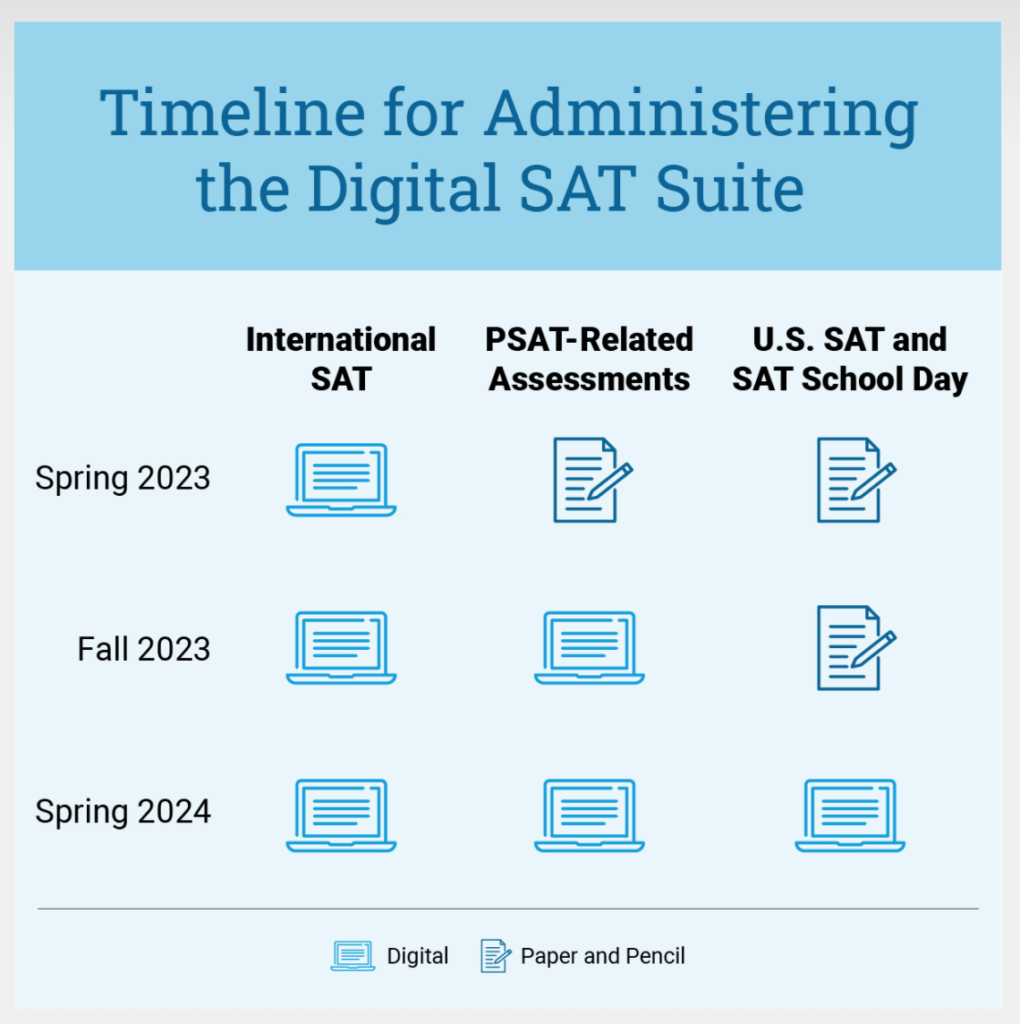
For current sophomores, juniors, and seniors in the United States, these updates will have no impact on their SAT test experience. Freshmen are scheduled to take the digital PSAT in the fall of their junior year–that will be their first experience with the updated digital format. These same freshmen would then be on track to take the digital SAT in the spring of their junior year–over two years from now.
The most important thing for any standardized test is to clearly demonstrate that it can make valid, fair predictions. So far, the digital SAT has only been administered in a pilot program to fewer than 500 students around the world. The College Board outlined their extensive research agenda for the digital SAT over the next 2.5 years:
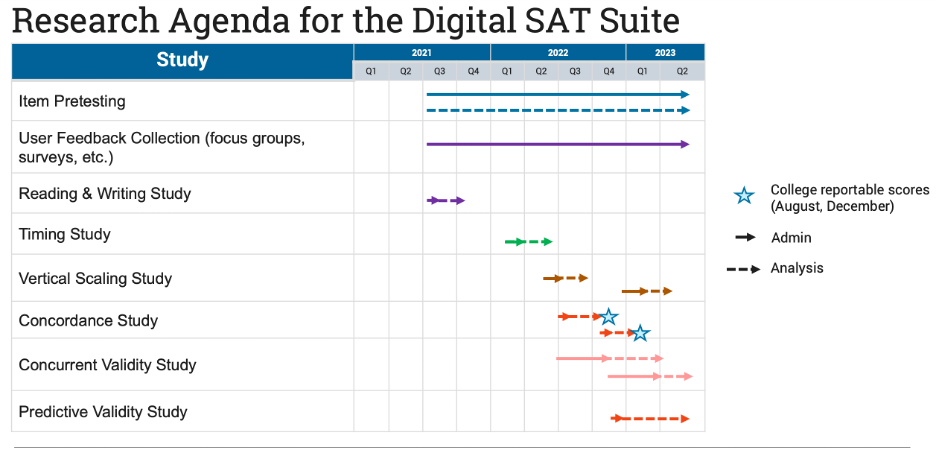
If the College Board cannot clearly demonstrate the predictive validity of the digital SAT, they will have to make adjustments to it or postpone its implementation. Here are some questions they will need to answer before they can pull this off:
The bottom line is that sophomores, juniors, and seniors do not need to worry about any of these changes. In the coming years, we will know much more about the specifics of the digital SAT as the College Board completes its research trials. If you have questions about the new digital SAT and PSAT, please reach out to us.
To be named a National Merit Scholar is a recognition for which students strive – they will earn accolades from their school, their parents, and their community. But is it as big a deal as people make it out to be? In my humble opinion, being named a National Merit Scholar is not nearly as important as it once was for a number of reasons.
With the Cold War over, American education is shifting towards inclusion and diversity. As a result, having one test – the PSAT – determine one’s eligibility for a scholarship is deemed by many to be too exclusive. In fact, the National Association for College Admission Counseling came out strongly against the use of the PSAT for this purpose:
http://www.insidehighered.com/news/2008/09/22/testing
As time goes on and the memories of the cold war fade, I imagine that colleges will continue to move away from emphasizing the PSAT and National Merit process, will look more comprehensively at a student’s academic and personal attributes when making scholarship and admissions decisions.
I hope you found this article helpful! If you did, please share it with your friends. Thanks, Brian Stewart
What should students do to prepare for the new PSAT?
1. Read widely and deeply. Students should read texts from a variety of content areas, from world literature to natural science, to become familiar with the types of materials they will encounter. The PSAT reading will not be difficult for most students to finish, so they should focus on learning to read well rather than read quickly.
2. Learn grammar fundamentals. Many students have not had thorough training in grammar. The new PSAT will expect students to thoroughly understand proper punctuation, parallelism, subject-verb agreement, and a host of other topics. Since grammar is often not taught in depth at many schools, students may want to review independently.
3. Brush up on algebra and statistics. There is very little geometry and trigonometry on the new PSAT. If someone is trying to qualify for a National Merit Scholarship, they will want to study geometry so they can be prepared for the handful of questions that will arise. If someone has more moderate goals, they can emphasize algebraic and statistical fundamentals.